通過Java IO流的形式實現(xiàn)鍵盤錄入的疑問
問題描述
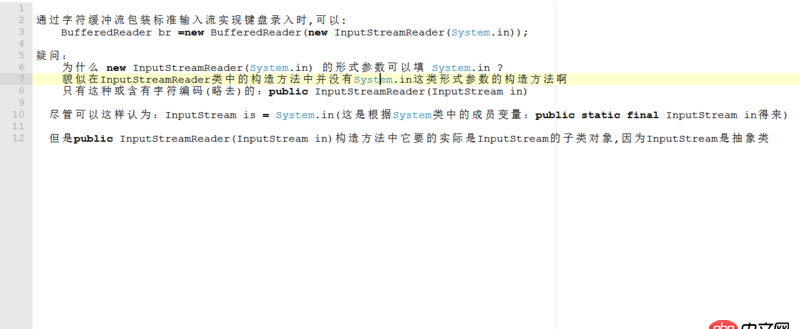
問題解答
回答1:因為System.in就是一個靜態(tài)的InputStream實例,你可以在java api文檔上看看
回答2:首先,System.in是一個InputStream類型的對象,在源碼里是這樣的:
/** * The 'standard' input stream. This stream is already * open and ready to supply input data. Typically this stream * corresponds to keyboard input or another input source specified by * the host environment or user. */public final static InputStream in = null;
可見System.in屬于標準輸入,可以通過鍵盤或其他方式輸入數(shù)據(jù)。但在源碼里,該對象并沒有(顯式)初始化的方法,通過閱讀源碼,可發(fā)現(xiàn)下面這個方法:
/** * Reassigns the 'standard' input stream. * * <p>First, if there is a security manager, its <code>checkPermission</code> * method is called with a <code>RuntimePermission('setIO')</code> permission * to see if it’s ok to reassign the 'standard' input stream. * <p> * * @param in the new standard input stream. * * @throws SecurityException *if a security manager exists and its *<code>checkPermission</code> method doesn’t allow *reassigning of the standard input stream. * * @see SecurityManager#checkPermission * @see java.lang.RuntimePermission * * @since JDK1.1 */public static void setIn(InputStream in) { checkIO(); setIn0(in);}private static native void setIn0(InputStream in);
閱讀注釋可見該方法用于設定研究setIn0(in),可見該方法是通過調(diào)用底層接口來實現(xiàn)in的設定,那么在軟件運行時,是如何初始化的呢?System類中有如下代碼:
/* register the natives via the static initializer. * * VM will invoke the initializeSystemClass method to complete * the initialization for this class separated from clinit. * Note that to use properties set by the VM, see the constraints * described in the initializeSystemClass method. */private static native void registerNatives();static { registerNatives();}/** * Initialize the system class. Called after thread initialization. */private static void initializeSystemClass() {...FileInputStream fdIn = new FileInputStream(FileDescriptor.in);FileOutputStream fdOut = new FileOutputStream(FileDescriptor.out);FileOutputStream fdErr = new FileOutputStream(FileDescriptor.err);setIn0(new BufferedInputStream(fdIn));setOut0(new PrintStream(new BufferedOutputStream(fdOut, 128), true));setErr0(new PrintStream(new BufferedOutputStream(fdErr, 128), true));...}
由此段代碼可知,軟件運行時,先運行靜態(tài)代碼塊,調(diào)用registerNatives()這個底層方法對System類進行初始化,該方法則是調(diào)用initializeSystemClass()方法來初始化System類的,這兩步都是通過VM實現(xiàn)的,然后閱讀initializeSystemClass()這個方法,可見到調(diào)用setIn0,setOut0,steErr0三段代碼,分別初始化了標準輸入,標準輸出,標準錯誤三種輸出流,至此System.in、out、err的初始化流程就都弄清楚了。標記為native的方法是JVM調(diào)用其他代碼實現(xiàn)的功能,這個和底層有關系,我覺得這個感覺就像是Bootstrap Classloader實際上是C實現(xiàn),但由JVM調(diào)用來加載各個基礎JAR classes相似吧。另外你說InputStream是抽象類(接口),實際上接口類抽象類都可以作為參數(shù),但實現(xiàn)肯定不是他們實現(xiàn)的,他們不能被實現(xiàn),但可以作為參數(shù),畢竟父類出現(xiàn)的地方子類都可以替代,所以這里不存在問題
相關文章:
1. javascript - sublime快鍵鍵問題2. javascript - immutable配合react提升性能?3. css - 寫頁面遇到個布局問題,求大佬們幫解答,在線等,急!~4. vue.js - Vue 如何像Angular.js watch 一樣監(jiān)聽數(shù)據(jù)變化5. javascript - nodejs關于進程間發(fā)送句柄的一點疑問6. 配置Apache時,添加對PHP的支持時語法錯誤7. phpstudy8.1支持win11系統(tǒng)嗎?8. javascript - vue-router 地址改變數(shù)據(jù)未改變9. 實現(xiàn)bing搜索工具urlAPI提交10. javascript - 移動端上不能實現(xiàn)拖拽布局嗎?

 網(wǎng)公網(wǎng)安備